founder skills

An open-source Claude plugin from lool ventures

Run the diligence on yourself first.

Six investor-grade analyses — your deck, your model, your market, your competition, your cap table, and a simulated investment committee — run on your own material, inside Claude Cowork. Free, open source, and script-backed: the numbers are computed, not narrated.

Free · Apache 2.0 · runs in Claude Cowork · your documents stay in your session

A real Cowork run reviewing a seed deck — prompt, narration, and the finished report landing in the Working folder. It takes minutes, not seconds; the recording is cut down and says so on screen.

How it works

Three steps, then a wait that is doing something.

01

Install the plugin

One install in Claude Cowork puts all six skills in the session. There is no account, no key, and nothing to configure.

02

Name the skill, hand it your file

Name it, and give it something to work with. A vague fundraising question may not fire anything; naming the skill and attaching the file is what reliably does. This is the most common first-run mistake.

Use the deck-review skill on our seed deck.

03

Get a report you can send on

Every skill writes a report.md and an HTML report to your Working folder. Three of them — cap table, financial model review, competitive positioning — also write an interactive explorer. Expect minutes: each run researches, computes and cross-checks before it writes a word.

The six skills

One plugin. Six analyses that read each other.

Each is script-backed: deterministic producers compute the scores and the math, and the model does judgment and research inside that structure. Run several and they compound — IC simulation imports your market sizing and deck review; competitive positioning cross-validates your competition slide against a prior deck review.

01Stays in your session

Deck review

Your deck read the way an investor reads it — slide by slide, at your stage, against a named principle each time.

Give it
A PDF, PPTX, markdown, or pasted slide text.
Get back
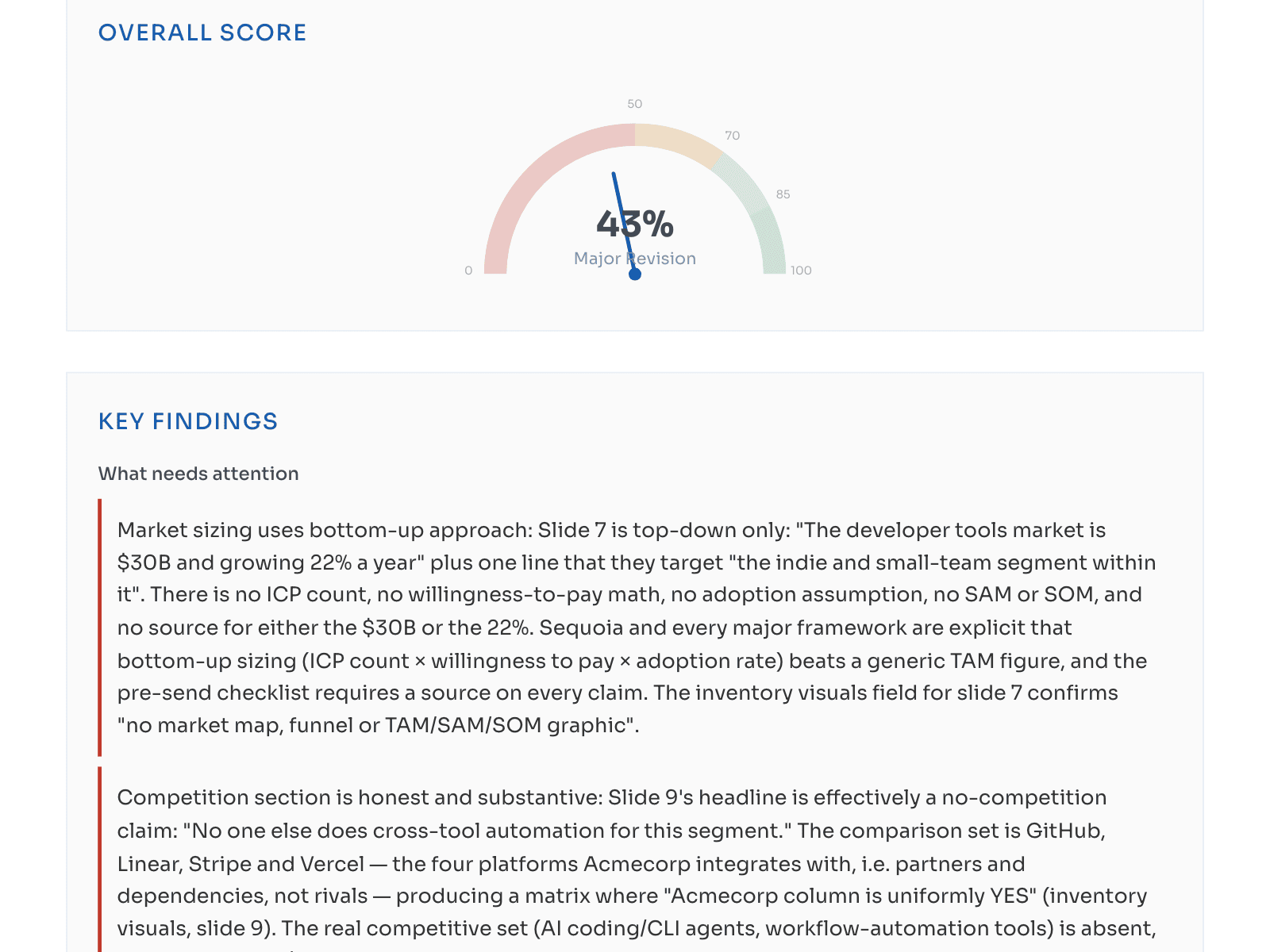
35 criteria scored across 7 categories, a slide-by-slide review, and an overall readiness rating — strong, solid, needs work, or major revision. Grounded in published investor guidance and data from Sequoia, DocSend, YC, a16z and Carta.

Use the deck-review skill on our seed deck.

02Stays in your sessionInteractive explorer

Cap table

What each instrument actually does to your ownership, with the rule that says so cited next to the number.

Give it
A signed or draft SAFE, convertible note, term sheet, option plan, warrant, articles of association, a Carta XLSX export — or just a described set of holders and instruments.
Get back
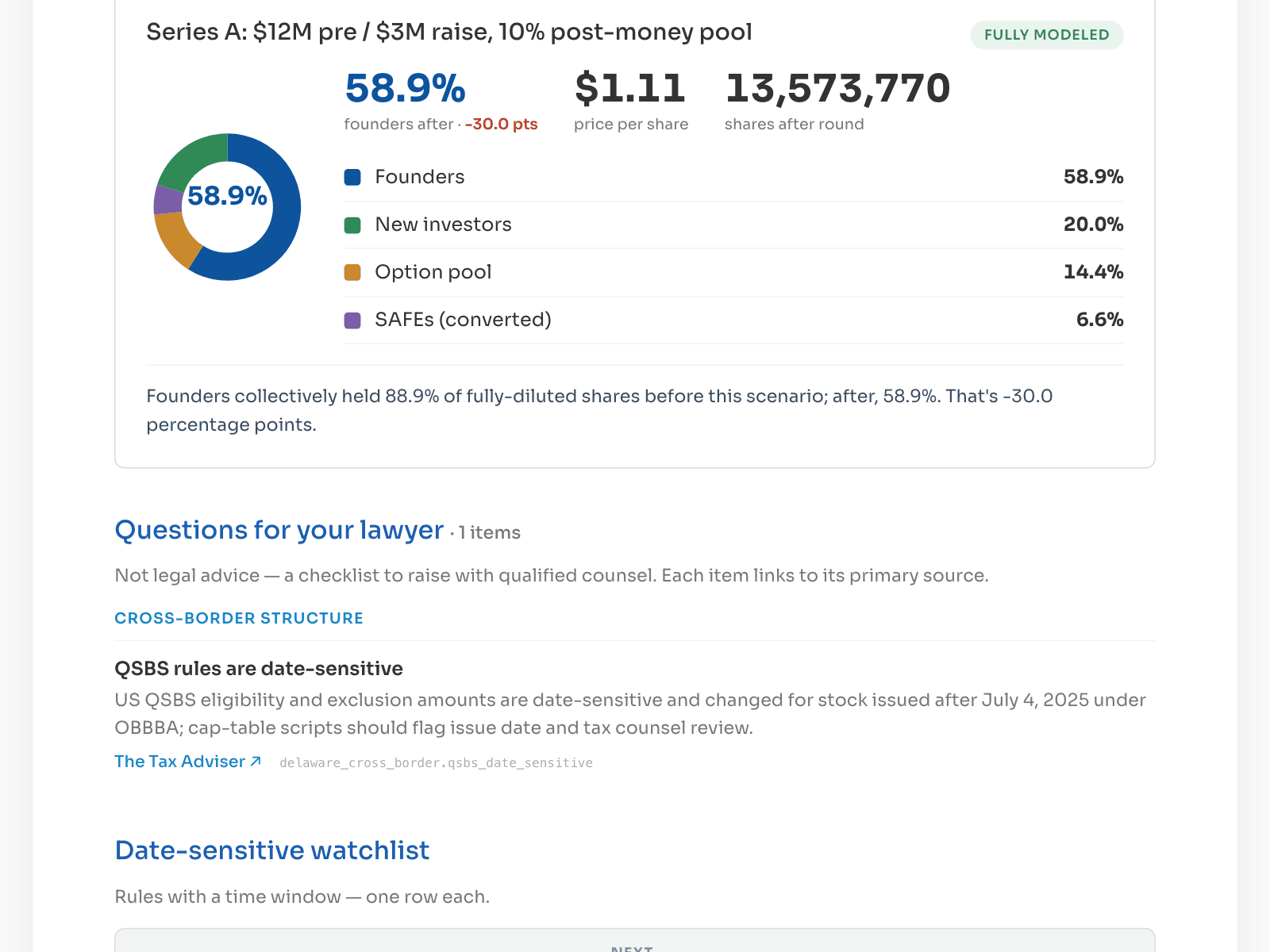
SAFE conversion across all forms — post-money cap, discount and MFN chains, cap-and-discount, and the legacy pre-money variants — full-branch convertible-note math, priced-round dilution with broad-based weighted-average, narrow-based or full-ratchet anti-dilution, pool top-ups, warrants, Israeli ↔ Delaware flips and dual-class voting. Pay-to-play provisions are detected and flagged for counsel rather than modelled. Plus a pre/post snapshot and a counsel-handoff packet. Every calculation cites a rule from a versioned pack sourced to NVCA model documents, the YC SAFE primer, Cooley GO and Israeli Companies Law — and the explorer's pre-money slider is not interpolated: every frame is a real solved round.

Use the cap-table skill on this SAFE and our current holders.

03Stays in your sessionInteractive explorer

Financial model review

Your model checked, benchmarked, and stress-tested to the month the cash runs out.

Give it
An .xlsx, a CSV, a link to a Google Sheet, the financial slides from your deck, or numbers described in conversation.
Get back
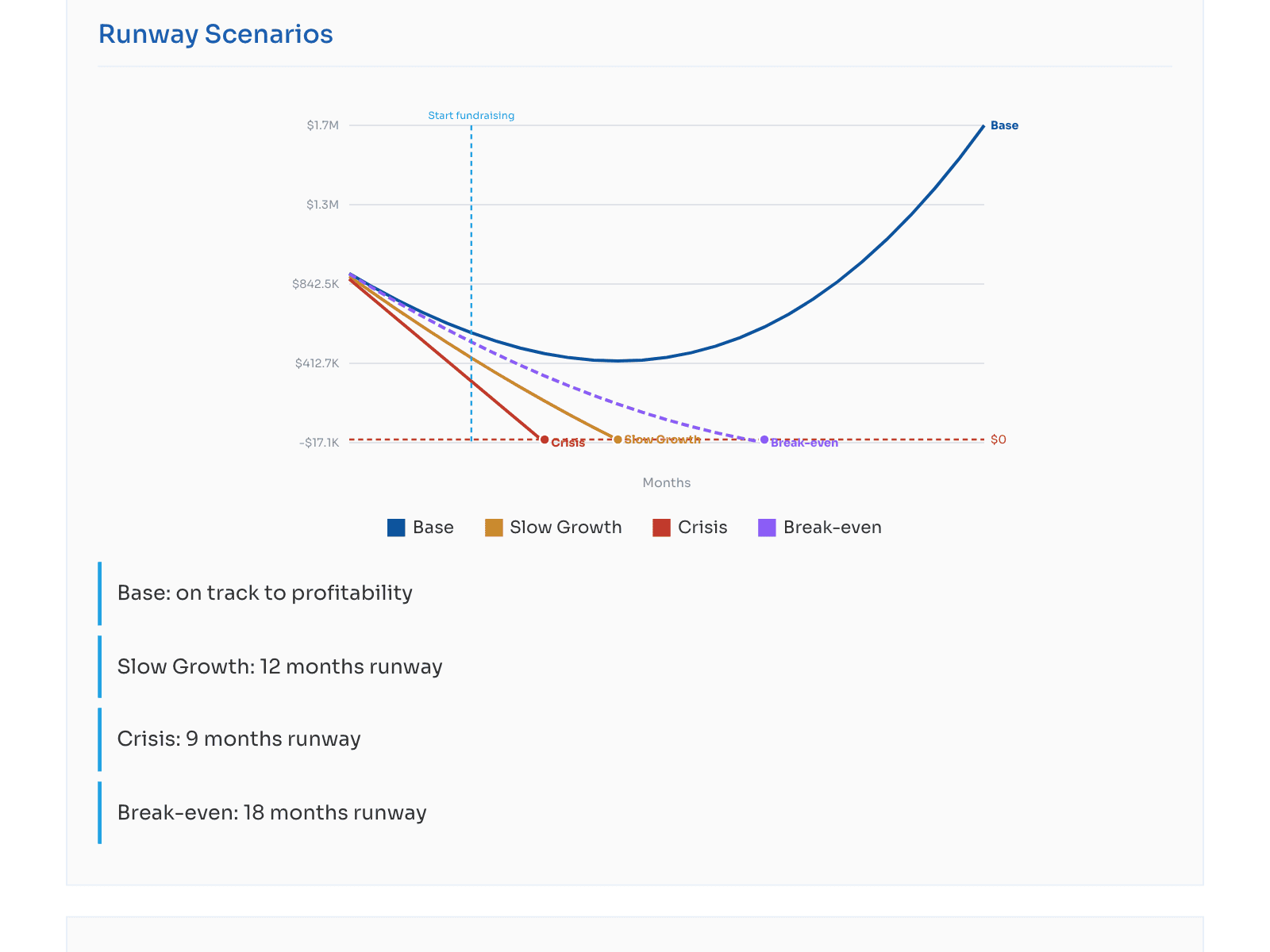
46 criteria across 7 categories, auto-skipping the ones that do not apply to your stage, geography or sector; 11 unit-economics metrics benchmarked against stage-appropriate targets; runway under base, slow-growth and crisis scenarios with cash-out dates, decision points and default-alive analysis. An extraction gate cross-checks what it read out of the spreadsheet against your own stated inputs first — including a model kept in thousands.

Use the financial-model-review skill on this model.

04Searches the web

Market sizing

A market number that survives the follow-up question, with the range it becomes when you are wrong.

Give it
A deck, a model, market data — or just a description of the business: product, customer, geography, pricing.
Get back
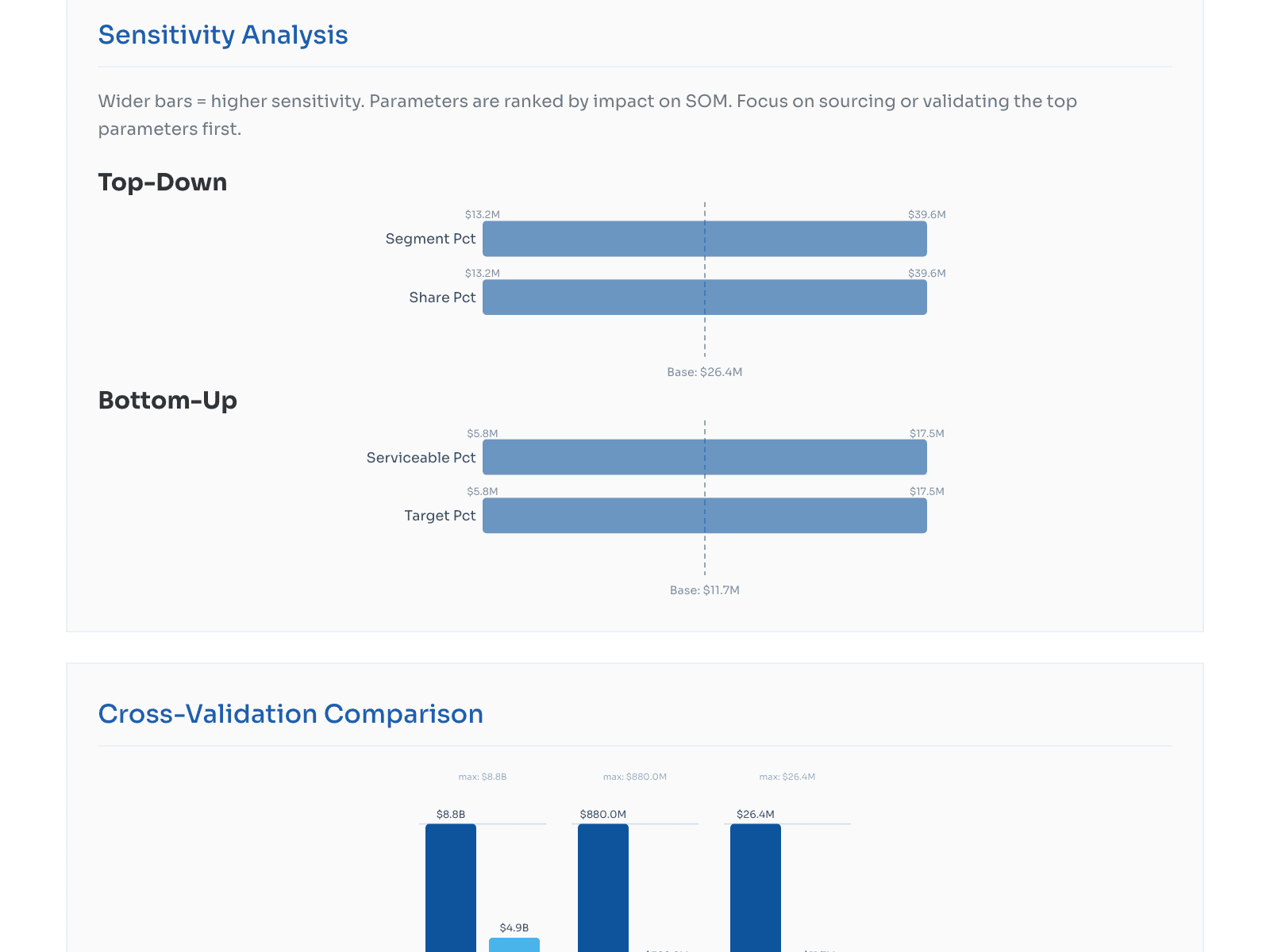
TAM/SAM/SOM top-down, bottom-up or both; sensitivity ranges that widen automatically when confidence is low; a 22-item self-check against common sizing pitfalls; and every figure cross-checked for internal agreement before anything is written. Claims are validated against analyst reports, government data and industry statistics.

Use the market-sizing skill for our business.

05Optional web searchInteractive explorer

Competitive positioning

The competitor missing from your slide, and the axis you chose because it flatters you.

Give it
A deck, a product description, or a conversation. It works best after a deck review, which it cross-validates against.
Get back
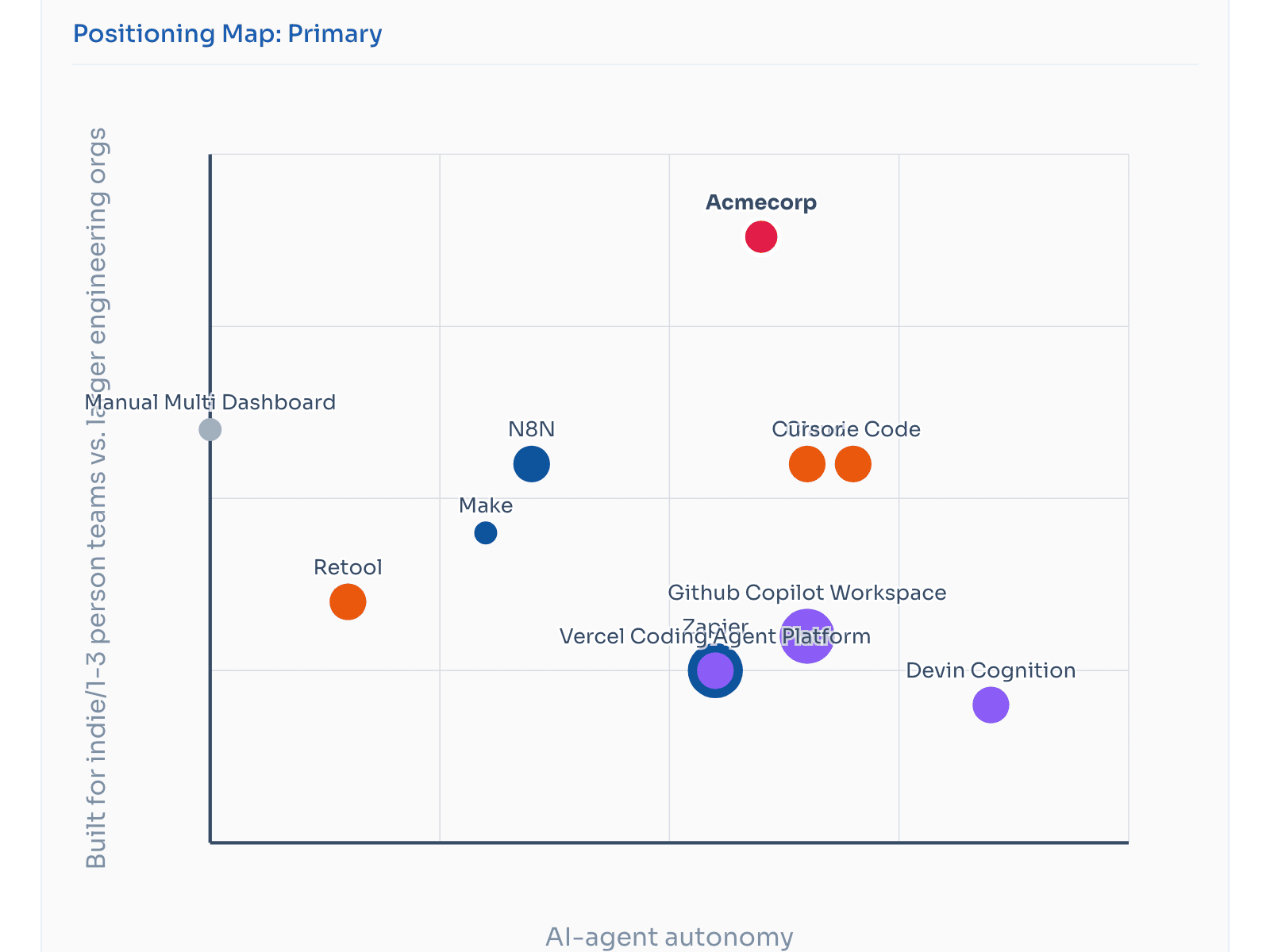
5–7 competitors across direct, adjacent, emerging and do-nothing; a positioning map that calls out an axis chosen to flatter rather than inform; 6 canonical moat dimensions per company with trajectory; differentiation claims stress-tested against evidence; a ~25-item quality checklist scoped to how much you gave it. The competitor set itself gets an adversarial pass — genuine, adjacent, or not actually a competitor, with reasoning — and it asks who is missing.

Use the competitive-positioning skill on our deck.

06Searches the web for a named fund

IC simulation

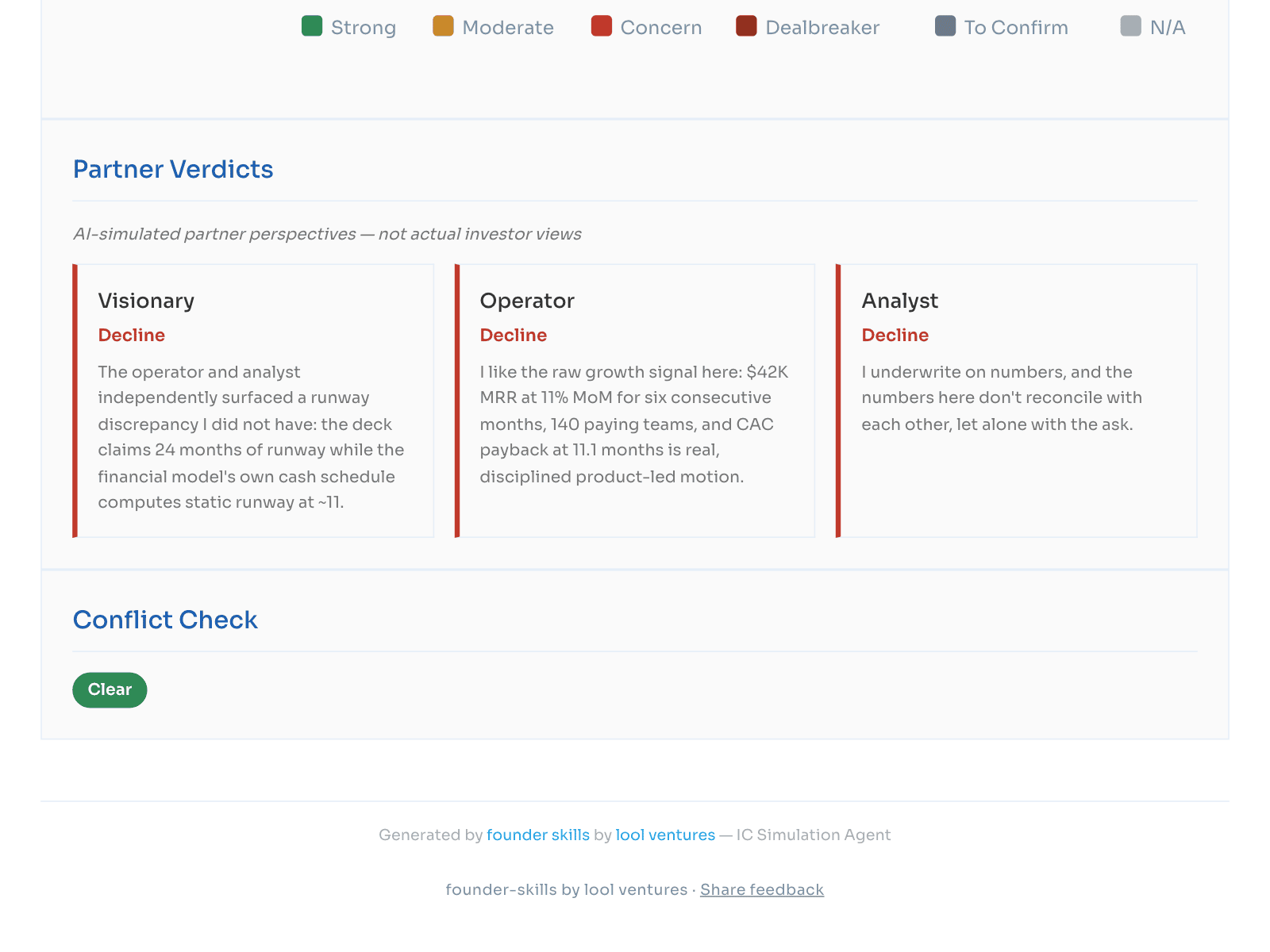
Three partners argue about your company. They form their views independently, so they genuinely disagree.

Give it
A deck, a model, data-room contents, or a description — optionally the name of a specific fund. Prior market-sizing and deck-review artifacts import automatically.
Get back
A simulated debate in three distinct voices — The Visionary on markets and timing, The Operator on execution and GTM, The Analyst on unit economics — scored across 28 dimensions in 7 categories, with conviction scores, a portfolio-conflict check, a consensus verdict — invest, more diligence, pass, or hard pass — and coaching on what to prepare before the real meeting.

Use the ic-sim skill on our deck and model.

What lands on disk

Output you would be willing to forward.

A written report and an HTML version for all six skills, written into your task's workspace under artifacts/<skill>-<company>/ and usually attached to the conversation too. Cap table, financial model review and competitive positioning add an interactive explorer. A cloud task's workspace is temporary, so download anything you want to keep. Every capture below uses a synthetic company.

Drag the pre-money and watch your ownership move. Nothing here is interpolated — each frame is a priced round solved from scratch, which is why the numbers stay honest at the extremes.

Why it holds up

The reason to use it is that the output survives someone reading it.

01

Deterministic producers, not vibes

Scores, conversions, dilution and runway are computed by versioned Python. The same inputs give the same numbers.

02

Cited to primary sources

Cap-table math cites a rule pack sourced to NVCA model documents, the YC SAFE primer, Cooley GO and Israeli Companies Law. Deck and model benchmarks are grounded in published investor data.

03

Anti-hallucination gates

An extracted figure has to clear the source before it is used: quote present, value present in the quote, value present in the document — plus real-world bounds checks. Competitor sets get an adversarial pass.

04

Cross-artifact consistency

Every skill validates its figures against each other before a report is written, so the report does not contradict itself.

05

Tested against the runtime it runs in

Beyond unit tests, every change to a skill replays recorded Claude Cowork runs, and every pull request statically analyzes each skill body — because the Cowork runtime differs from the CLI in ways unit tests cannot see.

06

Open source, Apache 2.0

Read exactly what it does before you run it on your own numbers. The source is here, and pull requests are welcome — a criterion we got wrong is worth an issue.

Privacy

Your documents stay in your session.

Nothing is collected, transmitted or shared with lool. There is no account, no telemetry, no analytics — not in the plugin, and not on this page. Feedback is opt-in and only ever sent when you ask for it.

Two exceptions, stated plainly

Three skills search the web

Market sizing always, IC simulation when you name a fund, competitive positioning optionally. Queries derived from your material pass through Claude to a search provider. The other three never touch the network.

One optional chart library

The competitive-positioning explorer's optional 3D tab loads a charting library from a public CDN the first time you open that tab. Everything else in every artifact is self-contained.

Install

Install once in Claude Cowork.

Claude Cowork — the way to run this

Install in Claude

Claude Cowork, inside the Claude desktop app, is where these skills are designed, tested and tuned. If you do it manually, two steps, in this order:

  1. Add the marketplace: lool-ventures/founder-skills.

  2. Then install the founder-skills plugin from it.

Two + buttons look alike. The first adds the marketplace; the second installs the plugin. Syncing a marketplace does not install anything — this is the most common failure.

Already live in a terminal? Claude Code works tooSecondary path
claude plugin marketplace add lool-ventures/founder-skills
claude plugin install founder-skills@lool-founder-skills

The producer scripts run locally, so you need Python 3.10 or later. Reading Excel models needs openpyxl and reading PDFs needs pdfplumber — install them if you hit a missing-module error on your first file. Artifacts land in artifacts/, in whatever directory you started from.

ChatGPT Work support is on the roadmap — it may already work, but we have not tested it.